

THE TROPHY
SECRET WEAPON X BTOMEC
FORMULA 1 SÃO PAULO GP 2026

SOUND, SCULPTED IN TITANIUM
2026 FORMULA 1 SÃO PAULO GRAND PRIX TROPHY
Designed by Secret Weapon. Manufactured at BTOMEC. Made in Brazil.
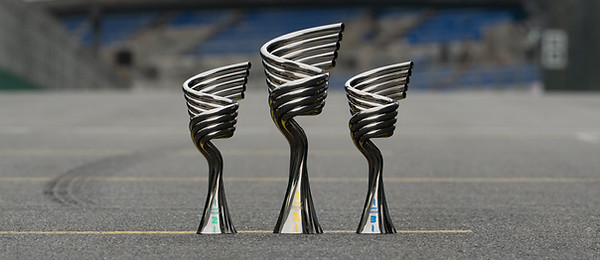
The 2026 Formula 1 São Paulo Grand Prix trophy translates the spirit of the V10 era into titanium. Conceived by Secret Weapon, it brings acoustic engineering, music and Brazilian motorsport heritage into one continuous sculpture.
ONE SCULPTURE. MULTIPLE PERSPECTIVES.
A design meant to be discovered.
The 2026 Formula 1 São Paulo Grand Prix Trophy was conceived as a sculpture with no single definitive viewpoint. A design meant to be discovered.
Rather than presenting its references through literal illustrations or applied symbols, the design integrates them into a continuous three-dimensional composition.
As the observer moves around the trophy, its contours shift, overlap and transform, revealing different interpretations of Formula 1, the Interlagos circuit, music and Brazilian identity.
Each perspective tells a different story. Yet every story originates from the same five titanium tubes.
THE SOUND OF THE V10
WHERE ENGINEERING BECOMES SCULPTURE.
The foundation of the design comes from one of the most recognizable elements of Formula 1's history: the exhaust manifolds of its legendary naturally aspirated V10 engines.
Five individual tubes evoke the exhaust runners of one cylinder bank, referencing the engineering responsible for carrying and shaping the engine's distinctive acoustic pulses.
These same five tubes establish the visual foundation of the sculpture, transforming a functional mechanical component into a language of movement, rhythm and form.
The exhaust manifold is not simply a reference added to the design. It is the starting point from which the entire sculpture emerges.


THE ''S'' CURVE
A TRIBUTE TO THE SOUL OF INTERLAGOS
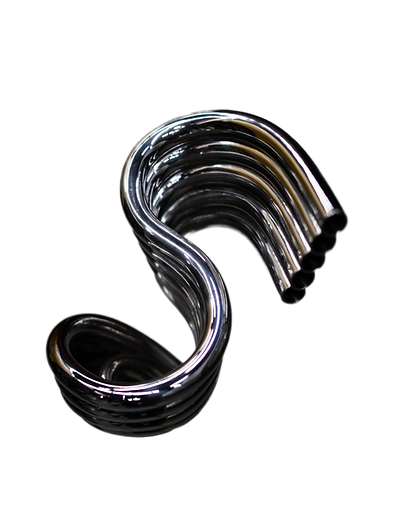
Viewed from above, the upper section reveals the unmistakable flowing geometry of the Senna S, one of the most celebrated sequences of corners in motorsport.
The reference extends beyond the circuit's two-dimensional outline.
The sculpture's spatial transitions also evoke the dramatic change in elevation as drivers descend through the corners, translating the topography of Interlagos into a three-dimensional movement.
It is a tribute not only to a legendary section of racetrack, but to the sensation of driving through it.

CHECKERED FLAG
THE MOVEMENT OF VICTORY
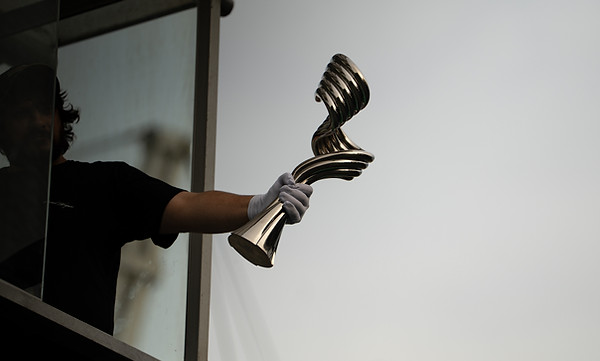
From another perspective, the sculpture's flowing lines take on the appearance of a flag caught in motion.
Its twisting surfaces suggest fabric rippling through the air, recalling the iconic checkered flag waved at the conclusion of a Formula 1 race.
Rather than reproducing the flag through colors or patterns, the design captures its movement.
A symbol of victory expressed through the geometry of titanium.
DESIGNED AND MADE IN BRAZIL
A NATIONAL IDENTITY HIDDEN IN THE CONTOURS


Viewed from the back, the outer silhouette suggests the geographical outline of Brazil, including the characteristic contours of its Atlantic coastline.
The shape is neither engraved nor superimposed on the sculpture.
It emerges from the relationship between the curves themselves, revealing a familiar national symbol through the arrangement of the five tubes.
What initially appears to be an abstract mechanical composition becomes a subtle representation of the country hosting the Grand Prix.

THE MUSICAL STAFF AND THE EIGHTH NOTE
WHEN ENGINEERING BECOMES MUSIC
The five exhaust tubes carry a second meaning: they represent the five parallel lines of a musical staff.
This connection brings together two worlds that share a fundamental relationship with rhythm, timing and frequency.
The unmistakable sound of Formula 1's V10 engines has long been regarded by enthusiasts as a form of mechanical music.
As the sculpture is observed from a different angle, its flowing silhouette also evokes an eighth note — or quaver — one of the familiar symbols of musical notation.
The reference celebrates both the musical character of the V10 era and Brazil's rich musical heritage.
Engineering becomes an instrument. Sound becomes a visual language.



THE KERBS OF INTERLAGOS
THE RACE TRACK, DOWN TO ITS SMALLEST DETAILS
At the base of the trophy, the forms recall the distinctive kerbs that define the edges of a racing circuit.
These elements connect the sculpture to the physical experience of racing at Interlagos: the racing line, the changes of direction and the boundaries that drivers approach in pursuit of every fraction of a second.
While the upper geometry celebrates the circuit's most recognizable corner, the base introduces another layer of motorsport identity.
A detail that might initially pass unnoticed becomes part of the larger story.
THE HIDDEN GEOMETRY
SÃO PAULO, MOVEMENT AND CONTINUITY
Other references emerge through the sculpture's transitions and negative spaces.
Certain contours suggest the letters S and P, a discreet reference to the initials of São Paulo.
The predominantly counterclockwise development of the geometry also reflects the direction of racing at Interlagos, one of Formula 1's relatively few counterclockwise circuits.
From selected perspectives, the intertwining curves may suggest the symbol of infinity, continuous motion or even organic forms.
These interpretations are not imposed on the viewer. They emerge through observation, allowing each person to discover additional relationships within the same structure.
 |  |  |  |
|---|---|---|---|
 |  |
A SCULPTURE THAT REVEALS ITSELF THROUGH MOVEMENT
The most distinctive characteristic of the trophy is not any individual symbol, but the way its meanings coexist.
A change in viewpoint transforms a mechanical component into musical notation, a circuit into a sculptural gesture, or a series of titanium curves into a symbol of national identity.
Nothing needs to be added or removed. Only the perspective changes.
ONE SCULPTURE. MULTIPLE STORIES. AN INVITATION TO KEEP LOOKING.
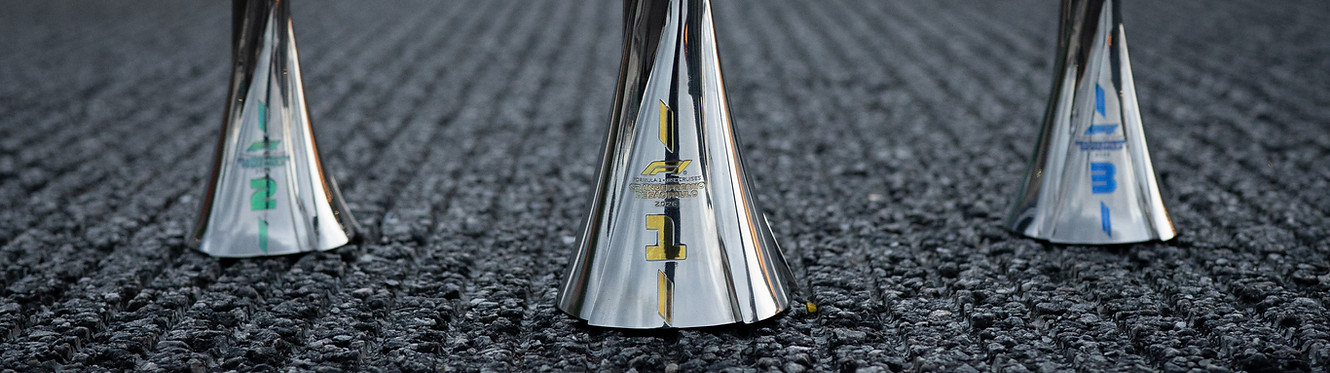
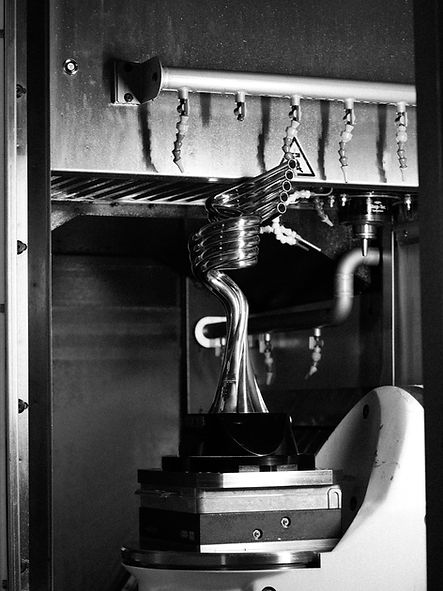
The Formula 1 logo and inscriptions are engraved directly into the titanium using five-axis CNC machining.
EVEN THE COLOUR COMES FROM THE METAL ITSELF
Through controlled oxidation, microscopic titanium oxide layers generate optical interference, producing shades of green, yellow, and blue inspired by the Brazilian flag.
ZERO PAINT - ZERO PIGMENTS - ZERO COLOUR COATING
JUST TITANIUM, ENGINEERING AND LIGHT.


A NEW MEANING AT EVERY TURN
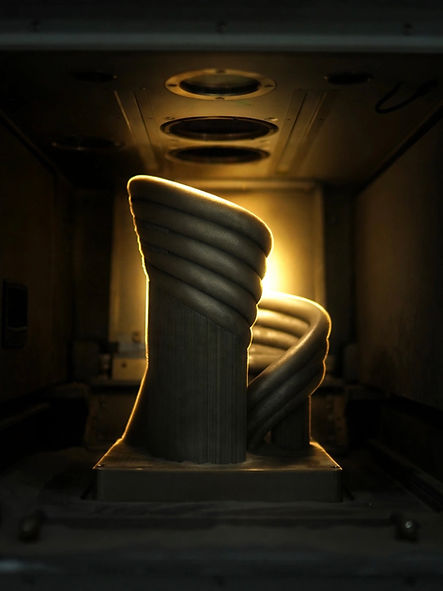
Manufactured by BTOMEC in Joinville, Brazil, the trophy is produced entirely from titanium using Selective Laser Melting (SLM), an advanced metal additive manufacturing process.
More than 20,000 individual layers are fused together to create its complex structure.
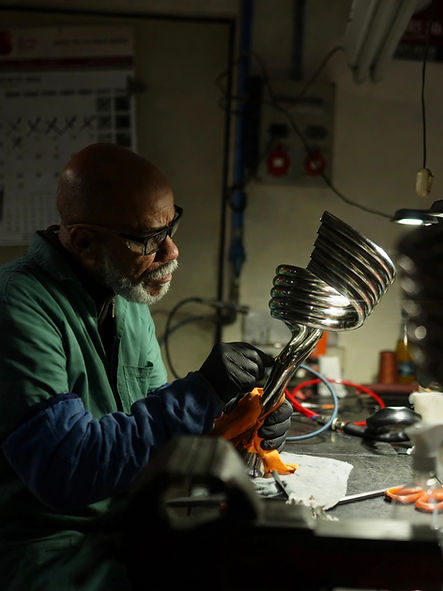
Each trophy requires approximately 190 hours of laser manufacturing, followed by 500 hours of precision finishing, combining advanced industrial technology with meticulous craftsmanship
20,000
FUSED LAYERS
190h
LASER MANUFACTURING
500h
PRECISION FINISHING
THE TROPHY
IN NUMBERS
55 cm high
5.7 kg of titanium
20,000+ additive manufacturing layers
190 hours of laser manufacturing
500 hours of precision finishing
10 months of development and production


Concept & Design: Secret Weapon — Fábio Castellotti, Fernando Lambiasi & Gabriel Fonte
Manufacturing: BTOMEC — Joinville, Brazil
OFFICIAL ANNOUNCEMENT & PRESS COVERAGE
Explore the project’s V10 inspiration, sculptural references and titanium manufacturing.
GP São Paulo — official announcement | ge — design and manufacturing | CNN Brasil — the design explained
THE STORY BEHIND THE TROPHY Engineering, music and Brazilian identity in titanium. The trophy for the Formula 1 MSC Cruises São Paulo Grand Prix 2026 transforms the sound of V10 engines into a titanium sculpture. Conceived by Secret Weapon and manufactured by BTOMEC, it brings together acoustic engineering, music, references to Interlagos and advanced manufacturing in a work made entirely from titanium. Designed by Fábio Castellotti, Fernando Lambiasi and Gabriel Fonte through Secret Weapon, and manufactured by BTOMEC Ferramentaria e Usinagem de Precisão in Joinville, Santa Catarina, Brazil, the project involved approximately ten months of development, production and finishing. Its interpretation changes with the viewing angle, while every perspective shares the same conceptual origin: the music of Formula 1 engines. THE ORIGIN: THE ENGINEERING BEHIND THE SOUND For decades, naturally aspirated engines, particularly V10s, gave Formula 1 one of its most memorable characteristics. Their intense, high-pitched timbre became part of the sport's historical identity, remaining in the memories of generations of drivers and enthusiasts. That acoustic signature is shaped by more than engine power or speed. Exhaust manifold geometry, runner lengths and the propagation and interaction of pressure pulses influence frequencies, resonances and harmonic content. This relationship between engineering and music is the starting point of the design. Five runners from one cylinder bank of a V10 engine. Five lines of a musical staff. This correspondence establishes the sculpture's fundamental language. The exhaust manifold is more than an aesthetic reference: the structure itself reproduces its mechanical language, while the tubes simultaneously become a visual musical score. The component that carries the engine's acoustic expression becomes a physical representation of its music. INTERLAGOS IN THE GEOMETRY Competition exhaust manifolds require complex curves to accommodate their runners and control their lengths within limited spaces. This engineering characteristic provided an opportunity to incorporate one of Brazilian motorsport's most recognizable references: the Senna S at the Autódromo José Carlos Pace in Interlagos. The five tubes were developed to evoke the S-shaped sequence, including its pronounced descent. The reference extends beyond a plan view of the track: the sculpture explores the circuit's topography and the perspective of watching cars negotiate the corners after the main straight. Its geometry connects the functional forms of an exhaust manifold with the dynamics of an iconic Formula 1 corner sequence. The tubes also develop counterclockwise, echoing the direction in which cars race at Interlagos. ONE SCULPTURE, MULTIPLE PERSPECTIVES The design was conceived to communicate its identity from more than one viewpoint. Development began with hand drawings before three-dimensional modelling. The frontal composition brought together the five exhaust runners, the five lines of a musical staff and the geometry of the Senna S. As the rear view developed, another visual relationship emerged: the silhouette approached the outline of Brazil. The proportions were refined to make this geographical reference more perceptible while retaining the identity of a trophy and the structural continuity of its elements. From one side, the structure resembles a rippling finishing flag, with the joined runners suggesting the flagpole. From another angle, the curves evoke an eighth note, also called a quaver. This rhythmic symbol represents duration within musical notation, connecting the manifold geometry with time and the cadence of engine pulses. It complements the musical staff: the five lines evoke a score, while the eighth note introduces the temporal dimension of music. Other perspectives suggest a treble clef and continuous forms reminiscent of a closed circuit or the infinity symbol, reinforcing movement, repetition and continuity. As the tubes rise, progressively perceived groupings culminate in all five runners, adding a sense of expansion and motion. At the base, the geometry references the circuit's kerbs, linking the sculpture to the track's boundaries and the visual identity of Interlagos. Every interpretation emerges from the three-dimensional structure itself, without relying on separately applied decorative symbols. The result retains formal unity while accommodating several narratives. A TROPHY THAT BELONGS TO INTERLAGOS The intention was to create an unmistakable identity for the São Paulo Grand Prix: an object whose form has a deep relationship with what it represents. The historic sound of engines, exhaust engineering, the Senna S, the finishing flag, circuit kerbs and Brazilian geography become parts of the same composition. Each reference retains its own meaning while contributing to a larger story. The sculpture makes something visible and tangible from one of motorsport's most emotional and intangible experiences: sound. ENGINEERING AS PART OF THE WORK The artistic philosophy also informs the choice of material and manufacturing method. Titanium combines mechanical strength and relatively low density, with established uses in demanding aerospace and motorsport applications. The structure is produced using Selective Laser Melting (SLM), a metal additive manufacturing process. Rather than removing or forming material to obtain the geometry, SLM builds it through successive thin layers of metal powder. A high-power laser follows digitally calculated paths and selectively melts the titanium powder. This operation repeats layer after layer until the complete geometry is formed. The process enables complex curves, transitions and geometrical features that are difficult to achieve with conventional machining. The São Paulo Grand Prix trophy comprises more than 20,000 layers. Each unit requires approximately 190 hours of laser manufacturing, followed by approximately 500 hours of finishing work involving technical procedures and manual interventions. BTOMEC carries out production in Joinville using high-precision industrial equipment. ADVANCED MANUFACTURING AND CRAFTSMANSHIP SLM is only one stage of production. Post-processing includes removal of manufacturing supports, surface treatment, manual finishing and electropolishing. The numerous curves and internal and external surfaces make these operations particularly demanding. Advanced industrial technology is combined with precise craftsmanship to achieve the intended finish. The Formula 1 logo and inscriptions are machined directly into the titanium using five-axis CNC equipment. Cut in low relief, they become integral to the metal rather than separately added components. Material, geometry, details and finish share the same engineering language. BRAZIL'S COLOURS COME FROM THE TITANIUM ITSELF The colour finish uses titanium's optical properties rather than paint, pigments or conventional coloured coatings. Controlled oxidation produces microscopic titanium oxide layers on the metal's surface. Their thickness affects the reflection of light, creating optical interference and different visible colours. The process produces shades of green, yellow and blue that together evoke the Brazilian flag when the trophies are seen on the podium. This is a physical expression of the material's properties. No paint. No pigments. No applied coloured coatings. The structure is entirely titanium, and even its colours arise from transformation of the metal's own surface. The finish connects national identity, materials science and technology. Brazil is represented not only through the trophy's forms and symbols, but also through the way its surface interacts with light. CELEBRATING BRAZILIAN TECHNOLOGICAL CAPABILITY The development brought together two Brazilian companies with complementary expertise. São Paulo-based Secret Weapon, a specialist in acoustic engineering and high-performance exhaust systems, contributed the artistic concept and the engineering language behind the project. BTOMEC Ferramentaria e Usinagem de Precisão, based in Joinville, translated that geometry into metal through advanced manufacturing and finishing. Together, they transformed a concept first developed on paper into a complex metal sculpture. The process brings together design, mechanical engineering, acoustics, additive manufacturing, precision machining, materials science and craftsmanship. Its manufacturing philosophy reflects the precision associated with Formula 1 components: each geometry requires planning, every stage demands technical rigour and every detail contributes to the result. Technology is both a means of production and part of the work's meaning. WINNER'S TROPHY: TECHNICAL SPECIFICATIONS Height: 55 cm Width: 22.5 cm Depth: 24.3 cm Weight: 5.7 kg Structural material: titanium Manufacturing technology: Selective Laser Melting (SLM) Additive construction: more than 20,000 layers SLM manufacturing time: approximately 190 hours per unit Finishing work: approximately 500 hours per unit Logo and inscriptions: five-axis CNC machining in low relief Colour: controlled oxidation and optical interference in titanium oxide layers Development, manufacturing and finishing: approximately ten months Concept and design: Secret Weapon — Fábio Castellotti, Fernando Lambiasi and Gabriel Fonte Manufacturing: BTOMEC Ferramentaria e Usinagem de Precisão — Joinville, Santa Catarina, Brazil ENGINEERING, MUSIC AND IDENTITY IN ONE WORK The 2026 Formula 1 São Paulo Grand Prix trophy brings together form, material, technology and meaning. Its geometry begins with a V10 exhaust manifold, becomes a musical score, follows the curves of Interlagos and reveals references to music, motorsport and Brazil from different viewpoints. Its production employs advanced technologies that reflect the precision and innovation associated with Formula 1. Beyond a symbol of victory, it pays tribute to the engineering that turned engines into musical instruments and to a circuit with a singular place in motorsport history. Conceived to honour sound, materialized through engineering and created to belong to Interlagos. The Formula 1 MSC Cruises São Paulo Grand Prix 2026 takes place on 6–8 November at the Autódromo José Carlos Pace in São Paulo.